What Is a Red-Light District? An Explanation of the History and Current State of Red-Light Districts as Part of Japan’s Adult Entertainment Culture
What Is a Red-Light District? An Explanation of the History and Current State of Red-Light Districts as Part of Japan’s Adult Entertainment Culture
2026-10-25
We’ll explain what a red-light district is, how areas with a concentration of adult entertainment establishments came to be, what these districts look like today, and how they differ from traditional brothels—all tailored for foreign visitors. Using Yoshiwara and Kabukichō as examples, we’ll also cover the basic rules to follow before visiting.
2026-10-25
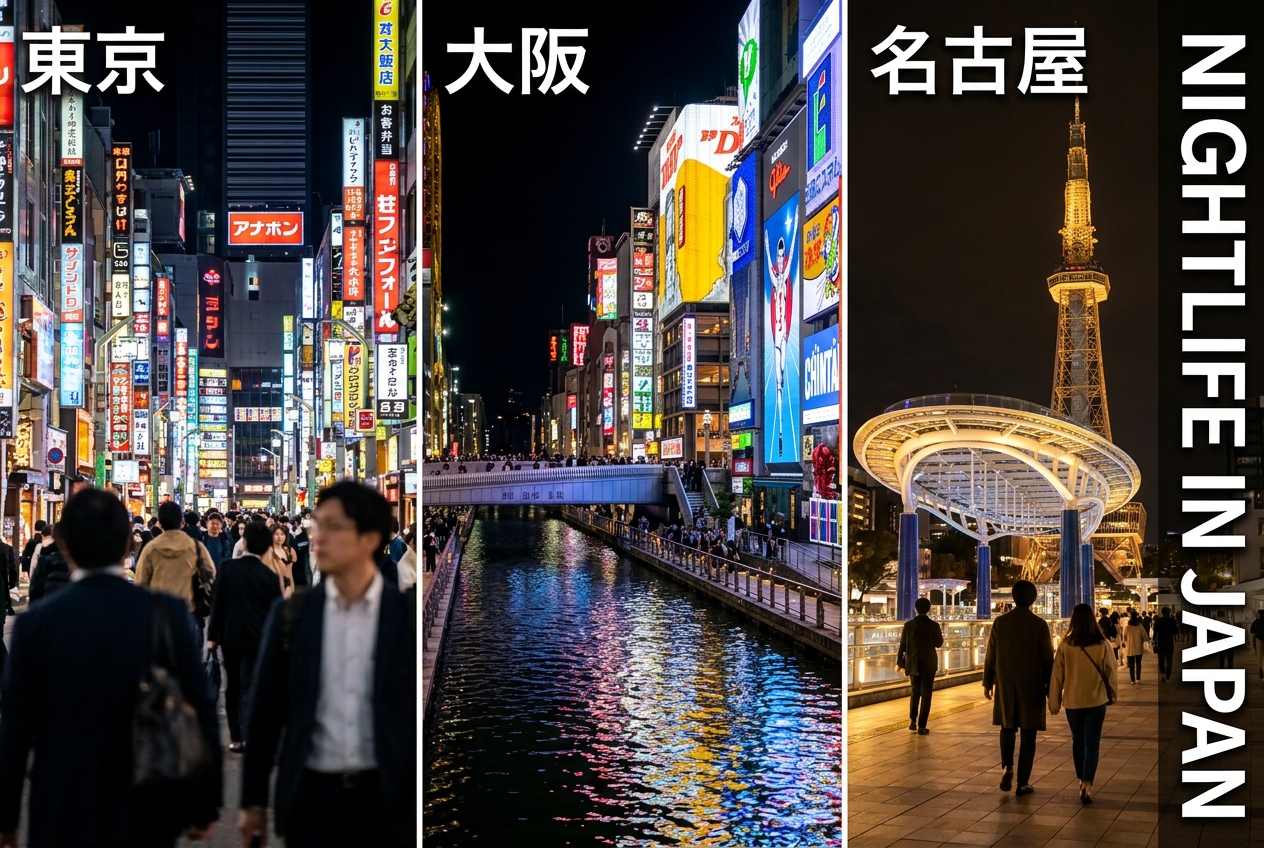
An “entertainment district” refers to a nightlife area where adult entertainment establishments, restaurants, and entertainment venues are concentrated. It is also known as a “nightlife hub” or “neon district.” Many readers, upon hearing names like Kabukichō or Susukino, are likely curious to know what these areas are like.
In Japan, there is also the historical term “yūkaku.” A yūkaku was a designated area where brothels that had obtained operating permits from the shogunate were concentrated, and the area was enclosed by walls or moats. Many people are curious about what has become of these yūkaku today. Under current Japanese law, yūkaku no longer exist. However, their history continues to influence today’s entertainment districts and adult entertainment culture.
In this article, focusing on entertainment districts where adult entertainment establishments are concentrated, we’ll explain the meaning of “entertainment district,” the history of yūkaku, the differences between yūkaku and entertainment districts, and the current state of yūkaku. We’ll also introduce the basic rules that foreign visitors should know before visiting adult entertainment establishments in these districts.
What Is an Entertainment District? The Meaning and Characteristics of a Nightlife District Where Adult Entertainment Establishments Are Concentrated
◆ The Basic Meaning of an Entertainment District
An entertainment district is an area where shops and facilities that people visit for enjoyment are concentrated. The term “entertainment” (kankaku) means to have fun or to derive pleasure. Because many of these establishments are open at night, they are characterized by flashy, eye-catching signs featuring neon lights.
General dictionaries describe entertainment districts as areas where restaurants and entertainment facilities are concentrated. This article focuses specifically on entertainment districts where adult entertainment establishments are concentrated. Understanding the origins of these districts is helpful for comprehending Japan’s adult entertainment culture.
◆ Characteristics of Entertainment Districts with Adult Entertainment Establishments
Entertainment districts with adult entertainment establishments share several common features.
・At night, the entire district is illuminated by neon and electric signs.
・Various types of establishments—such as soaplands, health clubs, and girls’ bars—are clustered closely together.
・Facilities used before or after visiting these establishments—such as love hotels, restaurants, and bars—are also nearby.
・There are still people on the streets even after the last train has departed, and many establishments remain open until late at night.
Not every establishment in these districts is an adult entertainment venue. The same area also includes izakayas, bars, residential buildings, and offices. It’s safer for patrons to check the location of their intended establishment in advance before heading out.
◆ Reasons Why Adult Entertainment Establishments Cluster in Specific Areas
The locations where brick-and-mortar adult entertainment establishments can operate are restricted by laws and ordinances. There are areas where such businesses are not permitted, such as near schools or residential neighborhoods. For this reason, adult entertainment establishments tend to cluster in specific areas where they have traditionally operated.
Some areas, like Yoshiwara, have a long history as red-light districts. Others, like Susukino, developed from former red-light districts into dining districts. There are also districts, such as Kabukichō, that emerged from postwar reconstruction plans. A defining characteristic is that each entertainment district has a different origin story.
◆ The Difference from Commercial Districts
Commercial districts are bustling commercial areas where department stores, restaurants, lodging facilities, and other commercial establishments are concentrated. Generally, the term “commercial district” refers to areas that are lively during the day, while “entertainment district” is used to emphasize areas that come alive at night.
However, there is no clear definitional distinction between the two, and in a broad sense, entertainment districts are included within the category of commercial districts. For example, Shinjuku is a famous commercial district, and Kabukichō, located within it, is referred to as an entertainment district.
◆ Japan’s Three Major Entertainment Districts
Kabukichō in Tokyo, Susukino in Sapporo, and Nakasu in Fukuoka are known as “Japan’s Three Major Entertainment Districts,” with Kabukichō in particular being the largest in the country. This designation is not an official ranking but rather a commonly used term.
◆ Entertainment Districts in Regional Cities and Hot Spring Towns
Entertainment districts are not limited to major cities. Hot spring towns and post towns visited by travelers often have areas known as entertainment districts. These tend to be less flashy than those in urban areas and generally have fewer establishments.
◆ Key Points of This Chapter
・“Entertainment district” is a general term referring to nightlife areas where adult entertainment establishments, restaurants, and entertainment facilities are concentrated.
・There is no clear distinction between these and “downtown” areas; the terms are used differently depending on the atmosphere during the day versus at night.
・Because adult entertainment establishments are restricted to specific locations, they tend to cluster in particular districts.
Major Adult Entertainment Sectors in Red-Light Districts | Understanding Store-Based vs. Outcall Services
Before visiting an adult entertainment establishment in an entertainment district, it’s helpful to understand the basics of the different business models. Here, we’ll briefly explain the most common types. For more detailed information on how they work, please refer to the related articles.
◆ Store-Based vs. Outcall Services
Store-based services are those where customers visit the establishment in person. Outcall services are those where staff visit a location specified by the customer. Entertainment districts are known as hubs for store-based establishments. Outcall services are typically used at accommodations or love hotels.
◆ Overview of Major Business Types
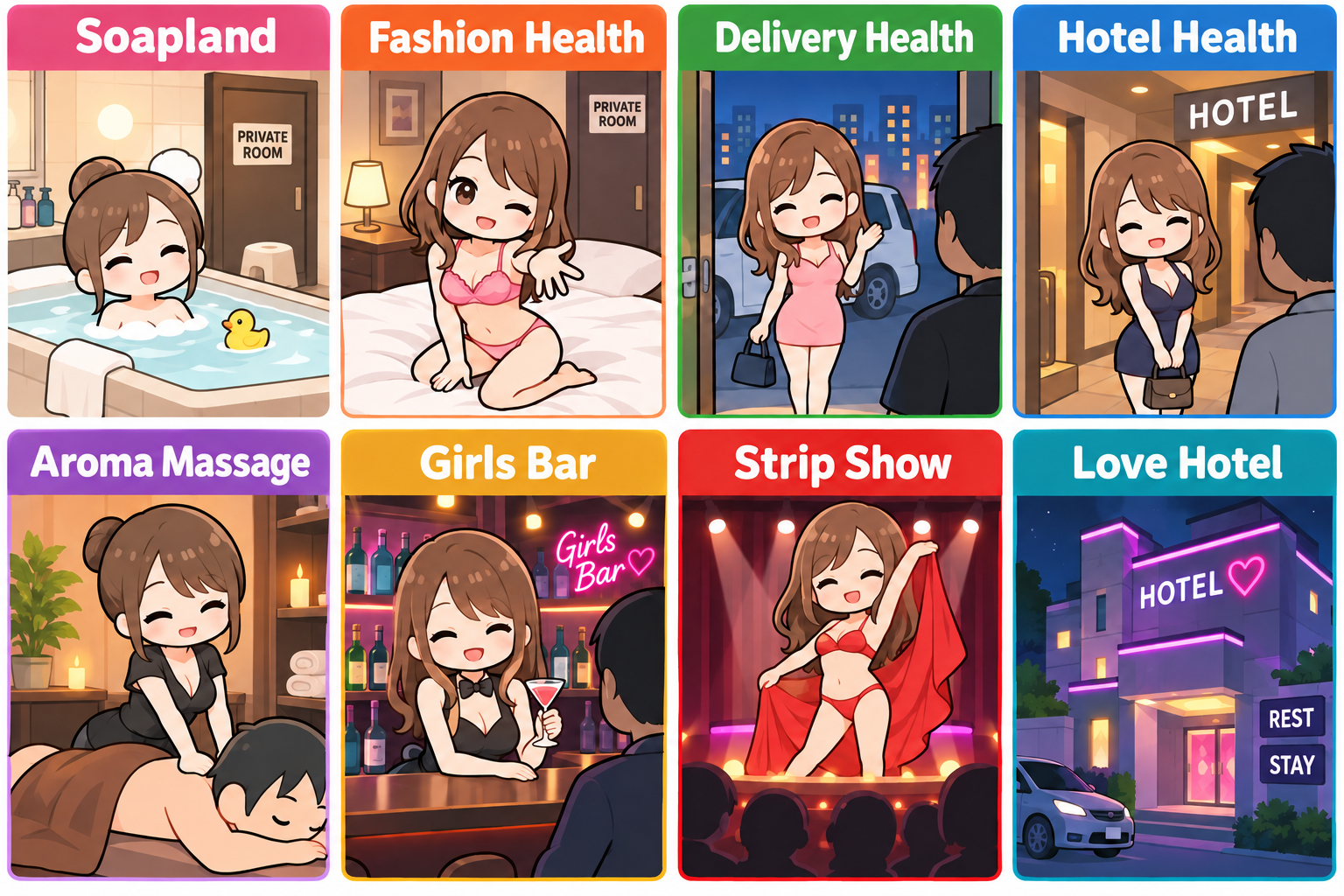
・Soaplands: A store-based business type. They are concentrated in areas such as Yoshiwara and Minami-Shinchi in Nakasu.
・Fashion Health: An in-store business where services are provided in private rooms within the establishment.
・Delivery Health: An outcall service where staff visit a location specified by the customer.
・Hotel Health: A service where customers meet staff at a hotel or similar location, or where staff visit the customer there.
・Adult Massage Parlors: Businesses that provide services centered around massage. These come in both in-store and outcall formats.
・Girls’ Bar: A bar where female staff serve customers from behind a counter.
・Strip Club: An entertainment venue where patrons watch dance performances and other shows in a theater setting.
・Love Hotel: A facility where guests can stay overnight or take a break. It is also used as a venue for outcall services.
Pricing structures and service details vary by business type. Please check the course details and prices on each establishment’s page before using the service.
What Is a Yūkaku? The History and Officially Designated Districts That Emerged During the Edo Period
◆ The Meaning of “Yūkaku”
A yūkaku was a designated district where brothels licensed by the shogunate were concentrated and surrounded by walls or moats. It was also called a “kurwa.” A brothel was an establishment that employed prostitutes to entertain clients.
The structure of a yūkaku differed from that of today’s entertainment districts. Entertainment districts are areas where establishments have naturally clustered together. A yūkaku, on the other hand, was a special district where the location and operations were strictly regulated by the government.
◆ The Beginnings of Yoshiwara
The most well-known yūkaku is Yoshiwara in Edo. Yoshiwara was established in 1617 as the only shogunate-sanctioned yūkaku in Edo. Initially located near what is now Ningyōchō in Chūō Ward, it was moved in 1657 to the area now known as Senzoku 4-chōme in Taitō Ward, which was then called “Asakusa Tanbo.”
◆ Why Red-Light Districts Were Enclosed
Red-light districts were designed as enclosed areas. Moats and walls served to obscure the interior from view and limit access points. Even in Sapporo’s Susukino district, an earthen rampart surrounded the red-light district, and a large gate was erected at the front. Being an area with restricted access was a major characteristic of red-light districts.
◆ Red-Light Districts as Part of Urban Planning
In some cases, red-light districts were established by the government as part of urban management. In Sapporo, the Kaitakushi (Colonization Commission) established an officially recognized red-light district in 1871. One reason for this is believed to have been the need to retain settlers in Sapporo. At that time, Sapporo had a large male population, and it is said that the Kaitakushi rushed to establish the red-light district out of concern for public safety.
◆ The Situation of Women Who Worked in Red-Light Districts
The history of red-light districts was not only bright but also marked by a grim reality. It has been documented that in the Yoshiwara district of the past, there were cases where women were sold into the red-light district and forced to work there.
Subsequently, criticism from both within Japan and abroad, along with years of advocacy by women’s groups and others, bore fruit, leading to the enactment of the Anti-Prostitution Law in 1956. Even when considering today’s adult entertainment establishments, it is essential to maintain an attitude that respects the dignity of the women who work there.
From the Red-Light District to the Present: The History of the Abolition of State-Sanctioned Prostitution, the “Red-Light District,” the Anti-Prostitution Act, and the Adult Entertainment Business Act
◆ Abolition of the Licensed Prostitution System in 1946
After Japan’s defeat in World War II, the General Headquarters (GHQ) demanded that the Japanese government prohibit human trafficking and abolish the licensed prostitution system. In January 1946, an order to abolish licensed prostitution was issued, and red-light districts such as Yoshiwara and Shimabara—which had existed since the Edo period—legally came to an end.
◆ The “Red Line” and the “Blue Line”
Even after the official prostitution system was abolished, there were areas where the business continued in the same locations. The “Red Line” refers to areas where prostitution took place with semi-official approval from the time of the directive abolishing official prostitution until the enforcement of the Anti-Prostitution Law in 1958. Areas where specialized entertainment establishments were concentrated were designated in various locations; because they were outlined in red on maps, they came to be called the “Red Line.”
Areas where prostitution took place secretly—while outwardly masquerading as inns or restaurants—were called the “Blue Line.” The Red Line, in some respects, carried on the structure of pre-war red-light districts.
◆ The 1958 Anti-Prostitution Law
The Anti-Prostitution Law was enacted in 1956. Provisions regarding the protection of women went into effect in April 1957, and the law was fully implemented—including its criminal provisions—on April 1, 1958. This law prohibits sexual intercourse with unspecified partners in exchange for compensation or the promise of compensation. With its full enforcement, the “red-light districts” were abolished. The history of the yūkaku also came to an end at this point.
The Anti-Prostitution Law remains in effect in Japan today. Foreign customers must also understand this law and use establishments that operate within the bounds of the law.
◆ How Have the Establishments in Yoshiwara Changed?
In Yoshiwara, the nature of business operations changed significantly after the law took effect. Establishments converted to love hotels, boarding houses, and Turkish baths. With the 1966 amendment to the Entertainment Business Act, Turkish baths were reclassified as “special bathhouses with private rooms,” and in the 1980s, they came to be known as “soaplands.”
◆ Current Adult Entertainment Establishments and the Law
Today’s adult entertainment establishments are not located in officially designated districts like the traditional red-light districts. Rules based on the Adult Entertainment Business Act and local ordinances apply depending on each business model. The 2006 amendment to the Adult Entertainment Business Act prohibited soliciting customers on the street.
The amended Adult Entertainment Business Act was enacted on May 20, 2025, and took effect on June 28 of the same year. This was prompted by issues such as host clubs exploiting customers’ romantic feelings to demand exorbitant food and drink charges, as well as problems arising from payment on credit. While referring clients to adult entertainment establishments had long been prohibited, the amendment now extends these regulations to the establishments receiving such referrals as well.
Laws and regulations are subject to change. Please check the latest information on the establishment’s page before visiting.
A Comparison Chart Outlining the Differences Between Red-Light Districts and Entertainment Districts
Let’s summarize what we’ve covered so far in a table. It’s easier to understand if you think of “yūkaku” as a “system” and “entertainment districts” and the like as “names for neighborhoods.”
Category
Red-light district (past)
Red-Light District (Present)
Adult entertainment district (present)
Meaning
A district containing officially licensed brothels
A commercial district with a high volume of foot traffic, featuring department stores, restaurants, and other businesses
A nightlife district where adult entertainment establishments, restaurants, and entertainment venues are concentrated
A district within an entertainment district where adult entertainment establishments are particularly concentrated
Relationship
A past system. Something distinct from the current district
The broadest concept. May include entertainment districts
Often forms part of a downtown area
Forms part of an entertainment district
Period
From the Edo period to the early Shōwa period
Still exists in various regions today
Still exists in various regions today
Legal Status
Does not currently exist as an institutional system
A general term with no clear definition
A general term with no clear definition
A general term with no clear definition
Boundaries of the City
A section enclosed by walls or moats, with limited entrances and exits
A commercial district extending around a train station
An area connected to the surrounding city where nightlife establishments are concentrated
A corner of an entertainment district or a specific neighborhood
Major Establishments
Brothels, teahouses, etc.
Restaurants, izakayas, department stores, etc.
Establishments such as soaplands and health clubs
Specific examples
Yoshiwara (Edo), Susukino Red-Light District (Sapporo)
Shinjuku, Tenjin
Kabukichō, Susukino, Nakasu
Yoshiwara, Minami-Shinchi in Nakasu
Operating Rules
Based on systems established by the shogunate or the government
Based on laws and regulations specific to each type of establishment
Based on the Entertainment Business Act and local ordinances
Based on the Entertainment Business Act and local ordinances
Current State
Traces Remain in Place Names, Intersection Names, Monuments, and Buildings
It continues as a bustling commercial district both day and night
Continuing to operate as a nightlife district
A district that continues to be home to a concentration of brick-and-mortar adult entertainment establishments
Not all entertainment districts originated as red-light districts. As explained in the next chapter, some districts developed from the sites of former red-light districts, while others were created as part of postwar reconstruction plans.
The Present State of Red-Light Districts | A Look at Former Red-Light Districts and Major Entertainment Districts Today
There are currently no legally recognized red-light districts in Japan. However, there are areas where the sites of former red-light districts continue to function as adult entertainment districts or nightlife districts. The origins of these districts differ depending on whether they developed from the sites of former red-light districts or emerged after World War II.
This chapter describes the current state of the major nightlife districts where adult entertainment establishments are concentrated. Knowing the location of each area and how to get around will make it easier to plan your visit.
◆ Yoshiwara (Senzoku, Taito Ward, Tokyo) | The District Best Known by the Name “Yoshiwara”
Location and Name: During the Edo period, Yoshiwara was located in what is now Senzoku 4-chome and part of Senzoku 3-chome in Taito Ward. Due to changes in the residential address system, the name “Yoshiwara” has disappeared from official administrative place names. However, “Yoshiwara Daimon” remains as the name of an intersection.
Access: The nearest stations are Minowa Station or Minami-Senju Station. If you walk along Dote-dori from Minowa Subway Station, you’ll reach the Yoshiwara Daimon intersection in about 10 minutes.
The Neighborhood Today: Today, Yoshiwara is known as one of Japan’s largest soapland districts. Under Tokyo Metropolitan Government ordinances, it is designated as a special zone where businesses can continue operating as long as they use existing buildings; however, the construction of new soapland buildings is prohibited. The buildings from the yūkaku era were destroyed in air raids; what remains today are structures from the postwar “red-light district” era.
Regulations: In 2012, the Tokyo Metropolitan Government designated Senzoku 4-chome as an area where not only soliciting and scouting but also loitering for such purposes is prohibited. In 2019, Senzoku 3-chome and 4-chome were designated as Special Enhanced Zones for the Elimination of Organized Crime. Even if someone approaches you on the street, do not follow them.
Key Points for Visitors: Yoshiwara is an area with a concentration of shop-based soaplands. Since you’ll be walking from the station, please check the distance to your train station or lodging in advance.
◆ Susukino (Sapporo, Hokkaido) | A Town Transformed from a Red-Light District to an Entertainment District
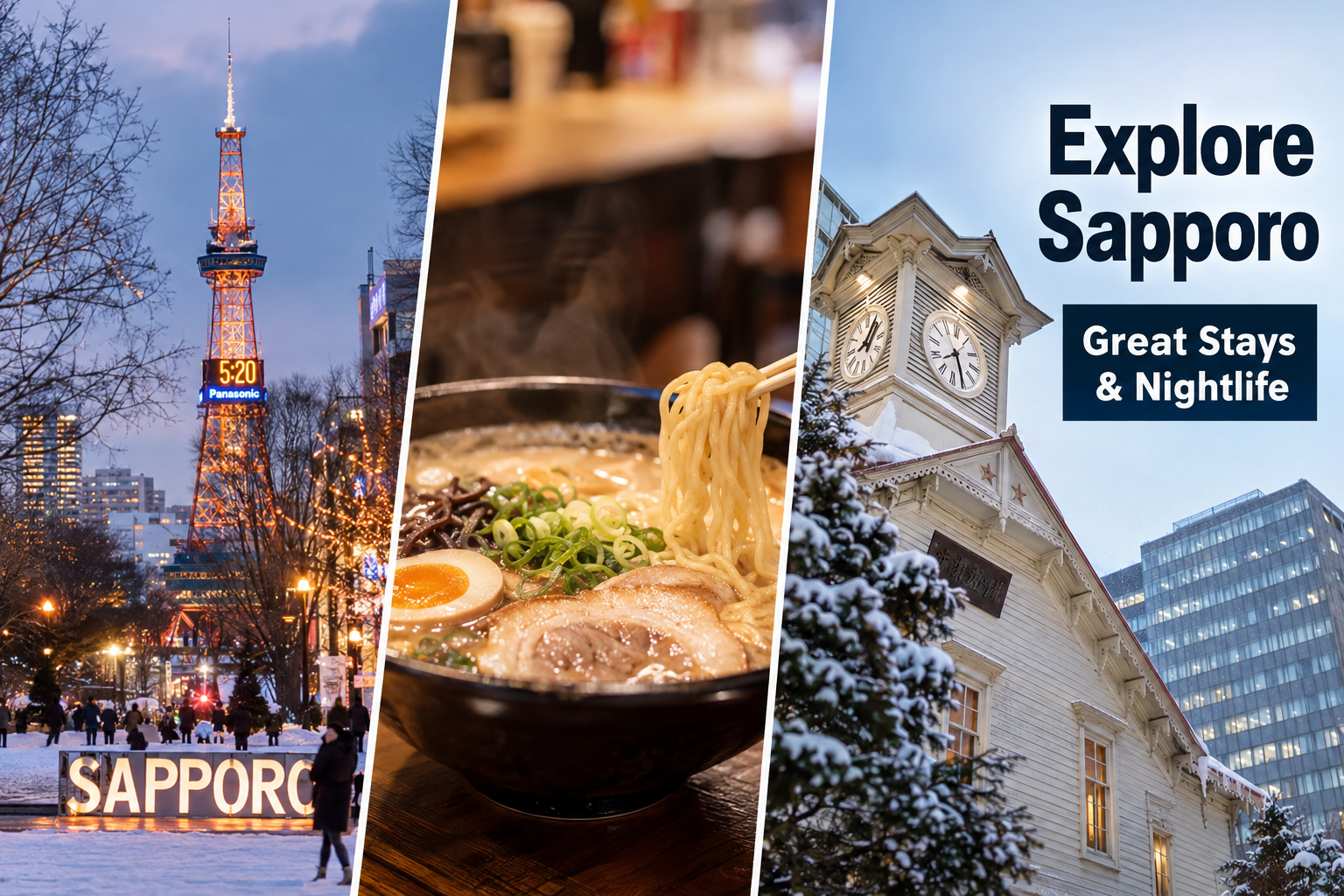
History: The name “Susukino” originates from the “Susukino Red-Light District,” an officially sanctioned red-light district established by the Hokkaido Development Commission in 1871. The red-light district moved to Shiroishi-cho in 1920, and the site was subsequently filled with cafes and other dining establishments, evolving into the neon-lit entertainment district we see today.
Location: Susukino, along with the area around Sapporo Station and the Odori district, forms the central business district of Sapporo. There is no specific address labeled “Susukino”; it generally refers to the area in Chuo Ward between Minami 3-jo and Minami 7-jo, and between Nishi 2-chome and Nishi 6-chome.
Traces of the Past and the Present: Within the grounds of Toyokawa Inari Shrine, there remain a tamagaki fence engraved with the names of brothels from the red-light district era, as well as a memorial monument dedicated to the souls of the courtesans. Today’s Susukino is home to over 3,000 restaurants, bars, and adult entertainment establishments.
Tips for Visiting: Shops in Susukino are concentrated within an area that is easy to explore on foot. In winter, due to snow and icy sidewalks, please wear comfortable walking shoes.
◆ Kabukichō (Shinjuku Ward, Tokyo) | A Neighborhood Born from a Postwar Reconstruction Plan
Origins: Kabukichō is not built on the site of a former red-light district. After being destroyed by air raids in 1945, a privately led reconstruction plan was implemented, and “Kabukichō” was established on April 1, 1948. The name originated from a plan to build a Kabuki theater, but due to funding shortages, the theater was never constructed, and only the neighborhood’s name remained.
The Neighborhood Today: Today, Kabukichō is Japan’s largest entertainment district, lined with movie theaters, izakayas, cabaret clubs, adult entertainment establishments, and host clubs. It is generally accessible on foot from the area around Shinjuku Station, and Seibu-Shinjuku Station is also nearby.
Tips for Visiting: Kabukichō has a large number of establishments, and the atmosphere varies from street to street. Please check the location on the establishment’s page in advance and head directly to your destination. Do not follow street touts.
◆ Nakasu (Fukuoka City, Fukuoka Prefecture) | One of Kyushu’s Largest Entertainment Districts, Flanked by Rivers
Location: Nakasu is located in Hakata Ward, Fukuoka City, in an area flanked by the Naka River and the Hakata River. It is about a 10-minute walk from Tenjin. Nakasu-Kawabata Station on the subway is the nearest station.
History: In 1834, the Fukuoka Domain developed a reclaimed area into an entertainment district. After suffering extensive damage during the Great Fukuoka Air Raid, movie theaters and other venues were rebuilt, and the area flourished once again as an entertainment district. Nakasu, too, is a district that developed not on the site of a former red-light district, but through the domain’s policies and postwar reconstruction.
Business Trends: On the south side of Kokutai Road lies a soapland district known as “Minami-Shinchi.” If you’re looking for brick-and-mortar establishments, it’s easiest to start your search from Minami-Shinchi.
◆ Tips for Finding Traces of Former Red-Light Districts
Even if no buildings remain, the history of former red-light districts is preserved in place names and monuments.
・Intersection and place names: Names indicating the entrance to a red-light district may remain, such as the “Yoshiwara Daimon” intersection.
・Tamagaki fences and monuments at temples and shrines: Names of brothels or memorial stones may remain, such as at Toyokawa Inari in Susukino.
・Locations of parks and hospitals: There are examples where the sites of large brothels or dedicated hospitals from the red-light district era have been converted into parks or public facilities.
・Block layout: The grid-like streets and structures with limited entrances and exits reveal traces of a planned layout.
Yoshiwara Park is located on the site where the “Daimonji-ro,” one of the four major brothels of Yoshiwara, once stood. These traces convey the history of the red-light district’s actual existence.
Laws and Etiquette You Should Know When Walking Through an Entertainment District Full of Adult Entertainment Establishments
Entertainment districts are home not only to adult entertainment establishments and restaurants but also to residential buildings and offices where people live and work. Foreign visitors must understand Japanese rules and etiquette when walking through these areas.
◆ How to Respond to Street Solicitors
Street solicitors who approach people to lure them into establishments may be violating prefectural ordinances or the Entertainment Business Act. In Shibuya Ward, an amendment to the ordinance effective April 2025 also prohibits the practice of standing on the street holding price signs to solicit customers.
Even if you are approached on the street, do not follow anyone without first confirming the price and details of the service. The safest approach is to check the establishment’s website in advance.
◆ Confirming Prices and Services
Under the 2025 amendments to the Entertainment Business Act, providing false information about prices or serving food and drinks that customers did not order are now subject to regulation. Before using a service, please confirm the total price and what is included.
◆ Guidelines for Use Based on the Anti-Prostitution Law
Under the Anti-Prostitution Law, having sexual intercourse with an unspecified partner in exchange for compensation is prohibited. Customers should use the services strictly within the scope provided by the establishment. If you are propositioned to engage in illegal acts, please do not comply.
◆ Consideration for Women Working in the Industry
Women working in adult entertainment establishments are individuals providing customer service. Please address them politely and follow the establishment’s rules. Avoid requesting acts they do not wish to perform or taking photographs without permission.
◆ Etiquette to Keep in Mind in Entertainment Districts
・Late at night, avoid shouting near residential areas.
・Do not take photos of other people or the exteriors of establishments without permission.
・Check the last train schedule in advance and decide on your mode of transportation home.
・Small establishments may accept cash only, so be sure to bring cash with you.
・Do not drink excessively, and keep an eye on your belongings and cell phone at all times.
Precautions for Foreign Visitors When Using Adult Entertainment Establishments in Red-Light Districts
◆ Language Support
All establishments listed on YOASOBI HEAVEN welcome international visitors. Since the YOASOBI HEAVEN chat feature supports automatic translation, users who are uncomfortable chatting in Japanese can still confirm details such as reservations, rates, and terms of service in advance.
When using in-person services, there may be situations where you need to speak with staff face-to-face after arriving at the establishment. Additionally, when communicating with the female companion during your visit, you can use a translation app as needed.
Please check the establishment’s page to see if it has staff who speak foreign languages.
◆ Reservations
For establishments listed on YOASOBI HEAVEN, contacting and making reservations via chat is the standard procedure. Since the establishment chat supports automatic translation, users who are unsure about communicating in Japanese can easily confirm their preferred dates and times, rates, service areas, and usage details in advance.
Depending on the establishment, you may also choose to make inquiries via general social media platforms or by phone. However, if you’re uncomfortable speaking Japanese over the phone, using the YOASOBI HEAVEN chat feature to confirm details first is likely the easiest option.
◆ Checking Rates
Rates vary by establishment and package. Please check the following items before using the service:
・Check the package details and base rate.
・Check if there are any optional fees.
・Check whether there are any extension fees.
・Check the payment methods.
・Check the latest pricing information on the venue’s page.
◆ Payment Methods
YOASOBI HEAVEN has a section where you can check the payment methods accepted by each venue. Please check the venue’s page before your visit to confirm whether payment methods other than cash are accepted and whether credit cards are accepted.
◆ The Difference Between Venue-Based and On-Site Services
Venue-based services are those where users visit the venue’s location to use the service. Outcall services involve staff visiting a location specified by the customer. If you’re staying near an entertainment district, you might prefer an in-store service for its convenience. If you’d like to use the service at your accommodation, you can consider an outcall service.
◆ Rules for Outcall Services and Accommodations
When using an outcall service, please confirm in advance whether your hotel or other accommodation allows visitors to enter the building or your room. Depending on the accommodation’s rules, you may not be able to use outcall services.
If the service is not available, you can visit a nearby love hotel to enjoy the outcall service there.
◆ Transportation and Time Management
Since many establishments in entertainment districts operate at night, it’s important to confirm your transportation options for the return trip. Check the last train schedule and the distance to your lodging in advance. We recommend allowing plenty of time and planning to arrive at the location before your scheduled appointment.
Summary
The term “entertainment district” refers to a nightlife area where adult entertainment establishments, restaurants, and entertainment venues are concentrated. There is no clear distinction between this and a “downtown” area; the terms are used interchangeably depending on the atmosphere during the day or night. Because adult entertainment establishments are restricted to specific locations, they tend to cluster in particular districts.
A “yūkaku” was a fenced-off district officially recognized by the shogunate during the Edo period. The yūkaku system came to an end following the abolition of licensed prostitution in 1946, the “red-light district” era, and the full enforcement of the Anti-Prostitution Law in 1958. Today, traces of this history remain in place names, monuments, and buildings.
Yoshiwara and Susukino are neighborhoods closely tied to the history of the yūkaku. Kabukichō and Nakasu are districts that developed as a result of postwar reconstruction and feudal domain policies. Since each entertainment district has a different origin, learning about the local history makes it easier to understand the differences between them.
When visiting adult entertainment establishments in these districts, please observe laws and etiquette, and confirm reservations, fees, and payment methods in advance. By using the YOASOBI HEAVEN store search, you can view information on all listed establishments in one place.
Frequently Asked Questions
Q. What is the difference between a “red-light district” and a “downtown area”?
A. The term “downtown area” is often used to describe a neighborhood where commercial facilities are concentrated and which is lively even during the day, while “red-light district” is often used to describe a neighborhood where establishments that operate at night are concentrated. However, there is no clear distinction between the two, and some neighborhoods, such as Shinjuku, possess characteristics of both.
Q. Do red-light districts still exist today?
A. Red-light districts no longer exist as an institutionalized system. With the full enforcement of the Anti-Prostitution Law in 1958, the red-light districts were abolished. Today, traces of this history remain in place names, monuments, and buildings.
Q. Can I use these services even if I don’t speak Japanese?
A. All establishments listed on YOASOBI HEAVEN welcome foreign visitors. The establishment chat feature supports automatic translation, so you can make reservations and check prices without needing to speak Japanese. If you visit an in-person establishment, translation apps can be helpful as needed for face-to-face conversations upon arrival or during your visit.
Q. Where can I check the payment methods?
A. Each establishment page on YOASOBI HEAVEN has a section where you can check payment methods. Please check the establishment page before your visit to confirm payment options other than cash and whether credit cards are accepted.
Q. When using the on-site service, what should I check at the hotel?
A. Please confirm in advance whether visitors are permitted to enter the building or your room. Depending on the accommodation’s rules, you may not be able to use the on-site service. In that case, you can use a nearby love hotel to access the on-site service.
City Heaven is one of Japan’s largest adult entertainment information sites. If you’re interested, try using the YOASOBI HEAVEN store search to find an adult entertainment establishment that suits your tastes.